
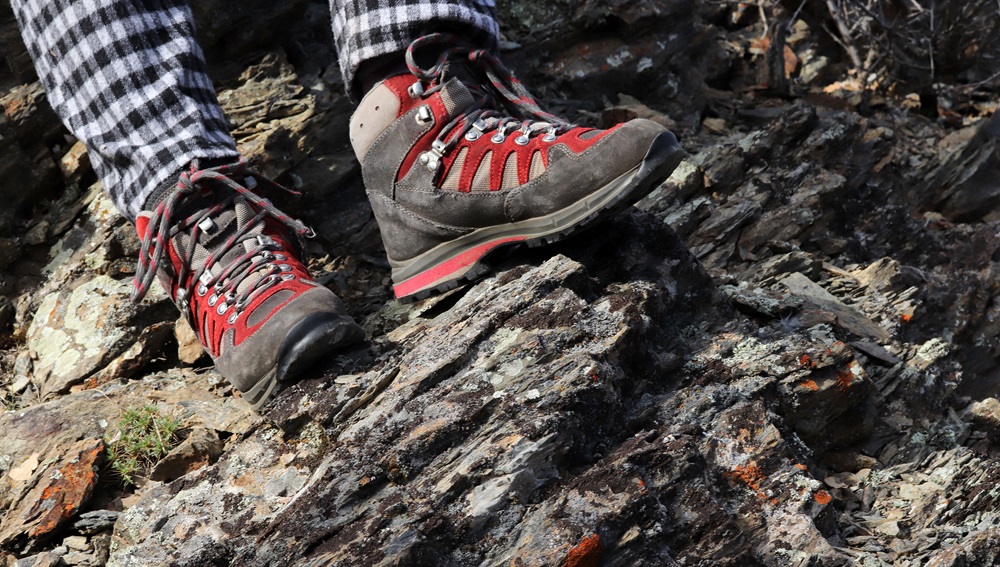
At high altitude, your boot choice can genuinely make or break a summit attempt.
Most men’s mountain climbing boots sit somewhere on a stiffness scale — and for technical routes, getting that wrong isn’t just uncomfortable.
It can be dangerous. Here’s what the ratings actually mean, and which one you need when things get serious.
The B-Rating System: What Does It Even Mean?
Mountaineering boots are graded B1, B2, and B3 based on sole stiffness and crampon compatibility. Think of it as a sliding scale from “stiff hiking boot” to “practically a ski boot.”
B1 boots have semi-rigid soles and work with strap-on C1 crampons. They’re fine for snowy trails and basic winter walking, but you’d never want them on steep ice.
B2 boots step things up with stiffer midsoles and a heel welt for C2 semi-automatic crampons — solid for glacier travel, alpine touring, and moderate technical routes.
B3 boots are fully rigid. There’s almost zero flex in the sole, they accept all crampon types including step-in C3 crampons, and they’re purpose-built for sustained front-pointing on steep ice and technical mixed terrain.
For any high-altitude route that involves real technical climbing — think routes above 5,000 meters with sustained ice sections — B3 is the minimum you should be considering.
Does Full Rigidity Actually Matter on Technical Routes?
Yes, and here’s the practical reason why.
When you front-point on steep ice, your crampon spikes are doing the work of keeping you attached to the mountain. But those spikes are only effective if the boot underneath them doesn’t flex.
If your boot bends as you climb, it changes the shape of the boot, loosens the crampon binding, and can cause it to pop off mid-pitch. That’s not a minor inconvenience at 6,000 meters.
A fully rigid B3 sole acts like a solid platform. Your calf muscles push directly through the boot into the crampon, and every bit of force you apply translates cleanly into the ice.
With a softer boot, you lose that energy transfer — your legs tire faster, your footing feels unstable, and the margin for error shrinks significantly.
Modern B3 boots also use carbon-fiber or fiberglass plates in the midsole instead of the old steel shanks.
These maintain rigidity while cutting weight — which matters more than people think at altitude, where every extra gram on your feet is multiplied over thousands of vertical meters.
B2 vs. B3 for Technical High-Altitude Routes
Here’s a straightforward comparison to help you decide:
| Feature | B2 Boot | B3 Boot |
| Sole stiffness | Semi-rigid, slight toe flex | Fully rigid, no flex |
| Crampon compatibility | C1, C2 | C1, C2, C3 (step-in) |
| Front-pointing performance | Limited on sustained steep ice | Excellent |
| Walking comfort | Better for long approaches | Uncomfortable on flat terrain |
| Best use case | Glacier travel, moderate alpine | Technical ice, mixed routes, 5,000m+ peaks |
| Insulation | Moderate | Higher (double boot options available) |
The honest answer: B2 boots can handle a lot. You can climb Mont Blanc in them.
But once your route involves sustained front-pointing, near-vertical ice, or you’re operating above 5,000 meters in cold conditions, B2 starts to show its limits. The crampon security alone is reason enough to go B3.
What About Comfort on the Approach?
This is the real trade-off people don’t talk about enough.
B3 boots are genuinely rough to walk in on flat or rocky terrain. Their rigid soles mean your foot can’t flex naturally with each step, which puts extra strain on your knees and hips over long distances.
Many experienced mountaineers solve this by wearing separate approach shoes for the hike in, then switching to their B3 boots at the base of the technical section.
If you’re doing a route that mixes a long rocky approach with serious technical climbing — you might want a second pair of shoes rather than compromising on boot stiffness.
Your summit boots should be chosen for the hardest part of the route, not the easiest.
Single vs. Double Boots: The High-Altitude Factor
Above roughly 5,000 meters, temperature becomes as important as stiffness.
Single B3 boots work well for technical alpine routes where you’re moving constantly and the cold is manageable.
But for multi-day expeditions on 7,000-8,000 meter peaks — like Denali, Aconcagua, or Himalayan objectives — double boots are the standard. These combine a rigid outer shell (B3 rated) with a removable insulated inner boot, allowing you to dry out the liner overnight at camp.
In temperatures approaching -50°F, that detail keeps your feet intact.
Modern double boots also use aerogel insoles and carbon-composite midsoles to balance warmth with weight. They’re heavy, but on a multi-week expedition above the death zone, warmth isn’t optional.
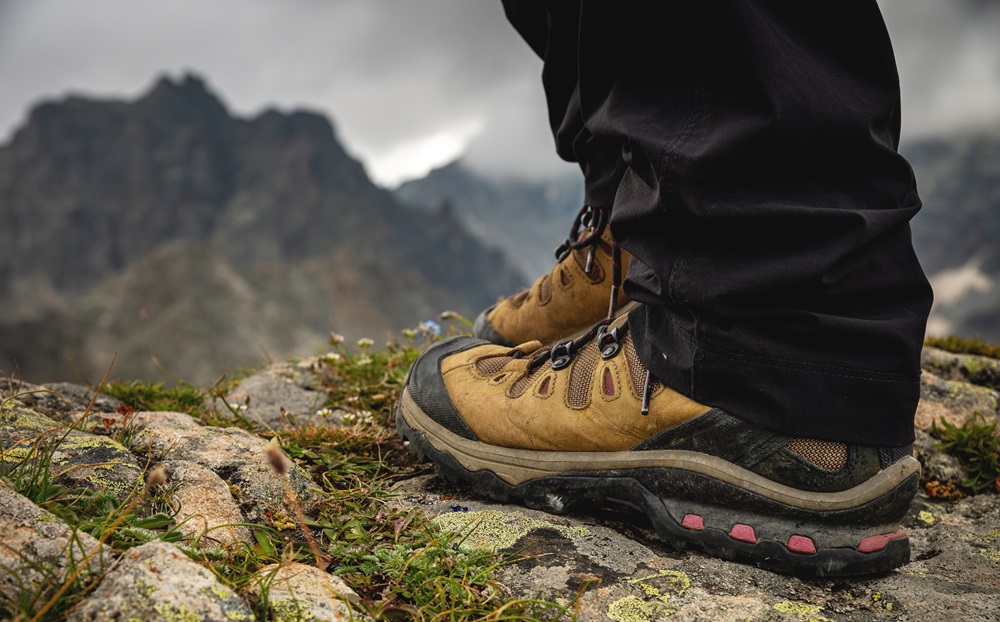
The Bottom Line on Boot Stiffness
For high-altitude technical routes, a B3-rated men’s mountain climbing boot with a fully rigid sole is the right choice.
If your route involves sustained ice, automatic crampons, or serious cold, there’s no good reason to go softer.
You can always wear more comfortable shoes to the base. But once you’re clipping in and heading up steep terrain, your boots need to be up to the task — and B3 boots deliver exactly that.
Frequently Asked Questions
What do B1, B2, and B3 ratings mean for mountain climbing boots?
Ans: They indicate sole stiffness and crampon compatibility, ranging from semi-rigid hiking-style boots (B1) to fully rigid technical climbing boots (B3).
Why are B3 mountain climbing boots recommended for technical high-altitude routes?
Ans: B3 boots provide full rigidity for secure crampon attachment and efficient front-pointing, essential for sustained steep ice and routes above 5,000 meters.
Can B2 boots handle high-altitude climbs?
Ans: B2 boots work for glacier travel and moderate alpine routes, but struggle with sustained front-pointing and technical ice above 5,000 meters.
What is the main downside of B3 boots?
Ans: Their fully rigid soles make walking on flat or rocky terrain uncomfortable, often requiring separate approach shoes for long hikes.
When should you choose double mountain climbing boots?
Ans: For multi-day expeditions above 5,000 meters, especially on 7,000–8,000 meter peaks, double boots provide essential insulation and removable liners for drying.