
A car accident in Phoenix can become overwhelming fast. One moment you may be driving on I-10, I-17, Loop 101, Loop 202, State Route 51, US 60, Bell Road, Camelback Road, Indian School Road, Thomas Road, McDowell Road, Baseline Road, or a neighborhood street. The next moment you may be dealing with traffic, heat, police, tow trucks, medical symptoms, insurance calls, repair estimates, and questions about who was at fault.
The first steps matter. You do not need to solve the whole claim at the scene, but you should protect your safety, document what you can, and begin an organized record before details disappear.
This guide explains what to do after a car accident in Phoenix, what records to save, how crash reports may work, what insurance companies may ask for, and when legal guidance may be useful.
Quick Answer
After a car accident in Phoenix, check for injuries, call 911 when needed, move out of traffic if safe, protect yourself from heat and roadway danger, exchange driver and insurance information, take photos and videos, collect witness details, look for nearby cameras, seek medical care, track the crash report, notify insurance, save repair and rental records, document missed work, and avoid signing a settlement release before understanding the full impact of the crash.
If the crash caused injuries, disputed fault, insurance delays, missed work, or a low settlement offer, speaking with a phoenix car accident lawyer may help you understand what evidence matters, what Arizona deadlines may apply, and how to protect your claim.
Key Takeaways
- The first hours after a Phoenix crash should focus on safety, medical care, scene documentation, reporting, insurance notice, and record organization.
- Phoenix car accident claims may involve freeway corridors, desert heat, wide arterial roads, construction zones, rideshare traffic, commercial vehicles, parking lots, pedestrians, cyclists, and hit-and-run drivers.
- Important records may include photos, videos, crash reports, medical records, repair estimates, witness details, insurance messages, wage records, rental receipts, and out-of-pocket expenses.
- Insurance companies may review fault, treatment timing, vehicle damage, statements, prior injuries, available coverage, and consistency across records.
- Arizona law can affect duties after a crash, injury deadlines, public-entity notice rules, and comparative-fault disputes.
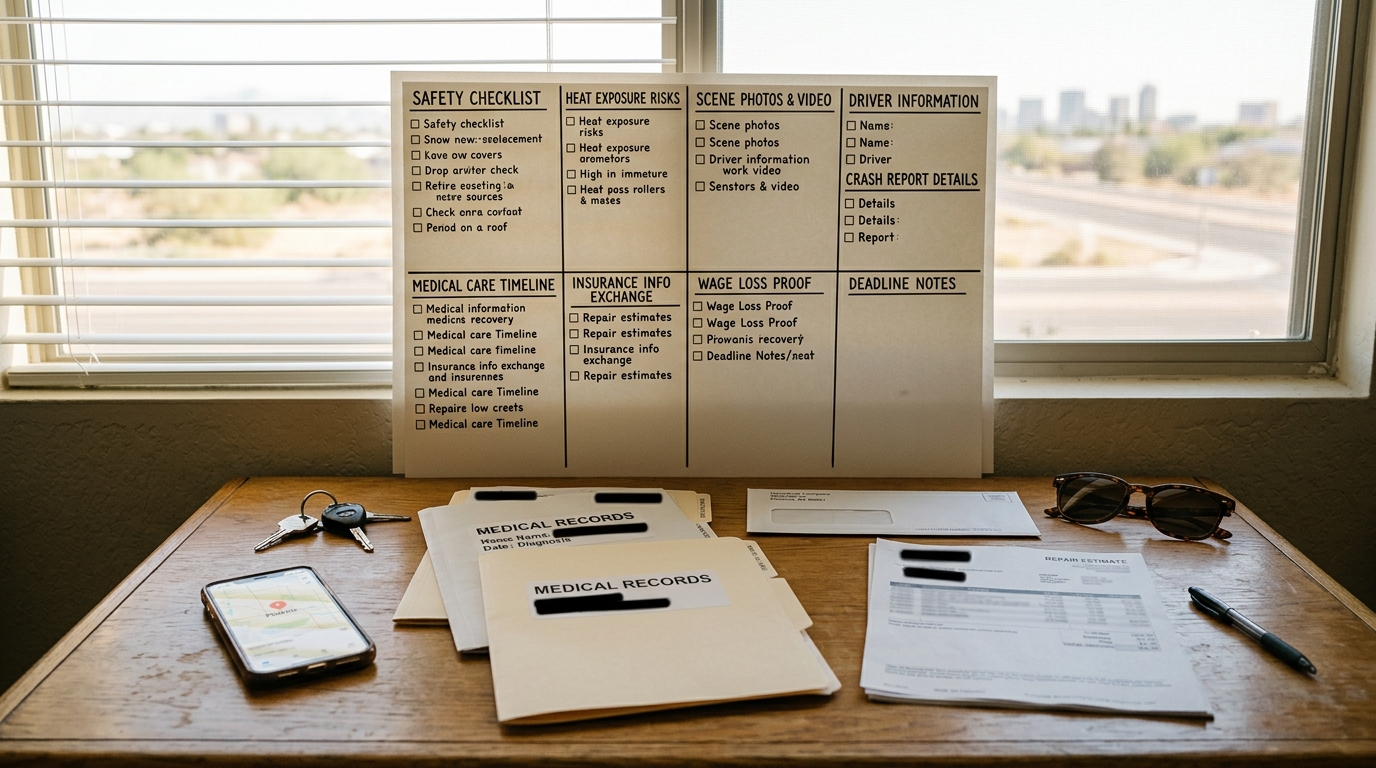
The Desert-Road Crash Action Board
After a Phoenix crash, think of the next steps as an action board with seven lanes:
- Safety and heat exposure
- Scene photos and vehicle details
- Driver, witness, and camera information
- Medical care and symptom tracking
- Police and crash report records
- Insurance and repair documentation
- Wage loss, expenses, and deadline questions
This structure helps keep the claim from becoming a scattered pile of paperwork. Each lane answers a practical question: what happened, who was involved, what injuries followed, what records exist, what insurance applies, and what deadline risks need attention.
Lane 1: Safety Comes Before Evidence
Your first priority is safety.
Check yourself, passengers, and others for injuries. Call 911 if anyone is hurt, confused, dizzy, bleeding, trapped, unconscious, or reporting pain.
Move out of active traffic if it is safe. Phoenix crashes can be especially dangerous on high-speed roads, freeway shoulders, ramps, frontage roads, and major arterials.
If it is hot outside, also think about heat exposure. Stand somewhere safe and shaded if possible. Do not remain near active lanes, leaking fluids, damaged vehicles, or debris.
Call police or emergency help when:
- Someone is injured
- A driver leaves the scene
- A vehicle cannot be moved safely
- Traffic is blocked
- A driver appears impaired
- The other driver has no insurance
- A commercial vehicle is involved
- There is a dispute about what happened
- The crash caused serious damage
Arizona law also requires drivers involved in certain crashes to provide information and render reasonable assistance to injured people when medical help is apparent or requested.
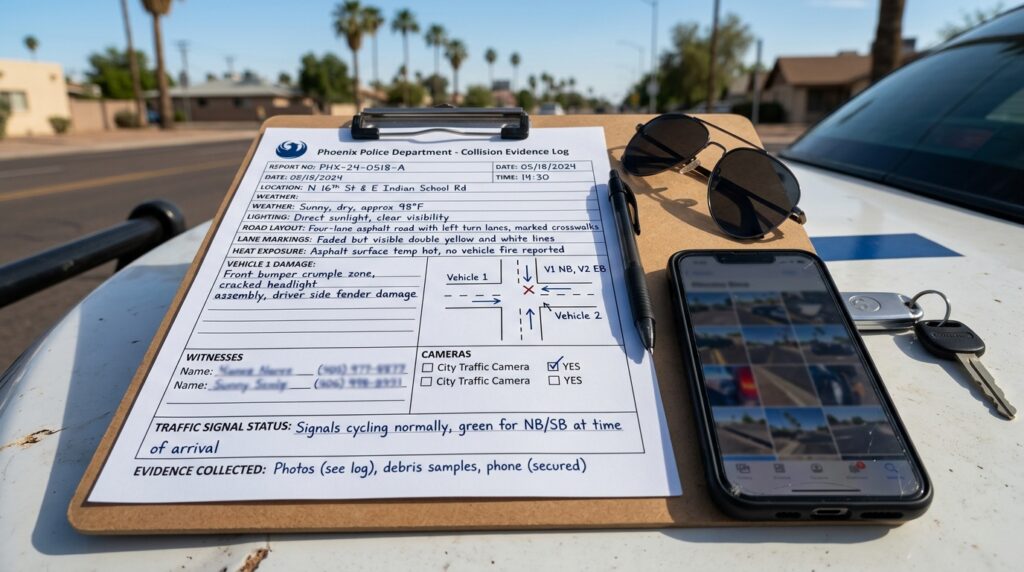
Lane 2: Photograph the Scene Before It Changes
Accident scenes change quickly. Vehicles move, debris is cleared, witnesses leave, tow trucks arrive, lighting changes, and nearby camera footage may be overwritten.
If safe, photograph:
- Vehicle damage from multiple angles
- License plates
- Final vehicle positions
- Road layout
- Lane markings
- Traffic signs and signals
- Skid marks or debris
- Weather and lighting
- Construction zones
- Nearby businesses
- Nearby cameras
- Visible injuries
- Damaged personal property
- Child seats, phones, glasses, helmets, or other damaged items
Take wide shots and close-ups. Wide shots show road design, lanes, signals, intersections, and vehicle positions. Close-ups show impact points, paint transfer, broken parts, debris, and damage details.
Do not stand in active lanes to take pictures.
Lane 3: Exchange Driver and Insurance Information
Exchange information with the other driver if it is safe.
Collect:
- Driver name
- Phone number
- Driver’s license information
- License plate number
- Vehicle make, model, and color
- Insurance company
- Policy number
- Vehicle owner information, if different from the driver
- Passenger names, if available
- Employer or company information, if a work vehicle is involved
- Rideshare or delivery trip details, if relevant
Take photos of documents if everyone agrees and it is safe. If the other driver refuses to provide information, leaves the scene, appears impaired, or lacks insurance, tell the responding officer or dispatcher.
Lane 4: Collect Witness and Camera Details
Witness information can become important when fault is disputed.
Ask witnesses for names and phone numbers before they leave. Witnesses may include:
- Other drivers
- Passengers
- Pedestrians
- Cyclists
- Scooter riders
- Store employees
- Security staff
- Parking-lot attendants
- Apartment staff
- Restaurant workers
- Rideshare passengers
- Delivery drivers
Also look for nearby cameras. Camera sources may include:
- Gas stations
- Restaurants
- Hotels
- Parking garages
- Apartment entrances
- Office buildings
- Retail centers
- Doorbell cameras
- Dashcams
- Rideshare or delivery vehicle cameras
- Commercial vehicle cameras
Write down the business name, address, and camera location. Do not assume footage will be saved automatically.
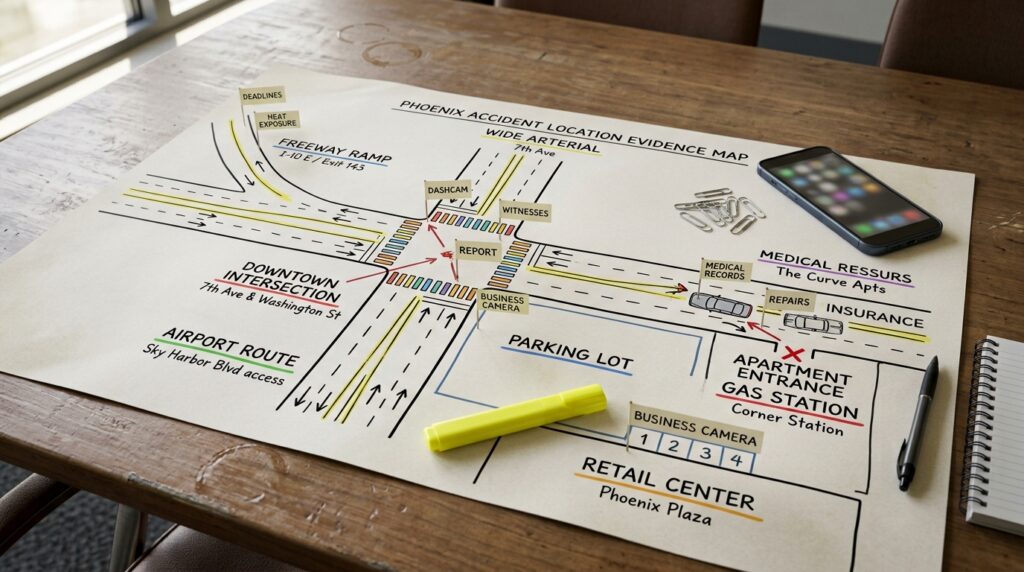
Phoenix Crash Settings: Why Location Matters
Phoenix crash claims often depend on the accident setting.
Freeways, Loops, and Ramps
Crashes on I-10, I-17, Loop 101, Loop 202, State Route 51, US 60, and connecting ramps may involve speed, merging, sudden stops, lane changes, freeway exits, construction, commercial vehicles, or multi-car impacts.
Evidence may include:
- Dashcam footage
- Exit and ramp details
- Tow records
- Vehicle resting positions
- Multi-vehicle witness information
- Crash report details
- Repair estimates
- Medical records
Wide Arterials and Intersections
Phoenix’s major surface streets can involve high speeds, long signal cycles, turning conflicts, pedestrian crossings, bicycles, scooters, buses, and rideshare or delivery traffic.
Evidence may include:
- Traffic signal photos
- Crosswalk photos
- Road layout photos
- Business camera notes
- Witness details
- Vehicle damage photos
- Medical records
Downtown, Airport, Campus, and Event-Area Crashes
Dense areas may involve pedestrians, rideshare pickups, scooters, delivery drivers, buses, parking garages, hotel entrances, airport routes, and business cameras.
Evidence may include:
- Rideshare receipts
- Parking garage details
- Business camera notes
- Time-stamped photos
- Witness names
- Police report information
Parking Lots, Apartments, Gas Stations, and Retail Centers
Parking-lot crashes may involve backing vehicles, unclear right-of-way, poor visibility, pedestrians, delivery vehicles, and cameras controlled by businesses or property owners.
Evidence may include:
- Store or property camera locations
- Vehicle-position photos
- Parking-lot layout photos
- Witness information
- Incident report details
- Damage photos before repair
- Medical records
Lane 5: Get Medical Care and Track Symptoms
Medical care matters even if symptoms seem mild at first. Adrenaline can hide pain after a crash.
Seek medical care for:
- Headaches
- Dizziness
- Confusion
- Neck pain
- Back pain
- Shoulder pain
- Knee pain
- Chest pain
- Abdominal pain
- Numbness or tingling
- Trouble sleeping
- Anxiety after the crash
- Symptoms that appear later
- Symptoms that worsen over time
Save records from:
- Emergency medical services
- Emergency rooms
- Urgent care clinics
- Primary care doctors
- Orthopedic specialists
- Neurologists
- Imaging centers
- Physical therapy providers
- Pharmacies
Also save:
- Discharge instructions
- Imaging reports
- Referral paperwork
- Prescription receipts
- Medical bills
- Follow-up appointment notes
- Work restriction notes
- Therapy attendance records
Insurance companies often review treatment timelines. Delayed care, missed appointments, unclear symptoms, or missing records may create disputes about whether the crash caused the injury.
Lane 6: Track the Phoenix Crash Report
A crash report can become an important part of a claim. It may document the accident date, time, location, drivers, vehicles, insurance information, reported injuries, witness details, citations, contributing factors, and officer notes.
The Phoenix Police Department’s public records materials include traffic crash records among public-record request types and direct users to the Police Public Record Request portal.
ADOT provides Arizona Crash Report forms and resources, including crash-report training materials for law enforcement personnel covering required fields on the primary crash form and Truck/Bus Supplement.
Save:
- Crash report number
- Responding agency
- Officer name, if known
- Crash date
- Crash time
- Crash location
- Driver and vehicle details
- Insurance information
- Witness details
- Citation information, if any
A crash report is helpful, but it is not the entire claim. Your photos, videos, witness details, medical records, repair estimates, and insurance messages may also matter.
Lane 7: Notify Insurance, But Keep It Factual
After a crash, you may hear from your own insurance company, another driver’s insurer, a commercial carrier, a rideshare insurer, a repair adjuster, or a medical payments representative.
You may need to provide basic facts such as:
- Date of crash
- Location
- Vehicles involved
- Policy information
- Claim number
- Whether police responded
- Whether medical care was needed
- Where the vehicle was towed
- Names of known witnesses
Avoid guessing about:
- Vehicle speed
- Distance
- Timing
- Visibility
- Fault
- Injury severity
- Future medical needs
- Whether you are “fine”
- What treatment will cost
If you do not know an answer, say you do not know.
The Arizona Department of Insurance and Financial Institutions advises drivers not to admit fault and not to discuss an accident except with police and insurance representatives.
Organize Repairs, Rentals, Wages, and Expenses
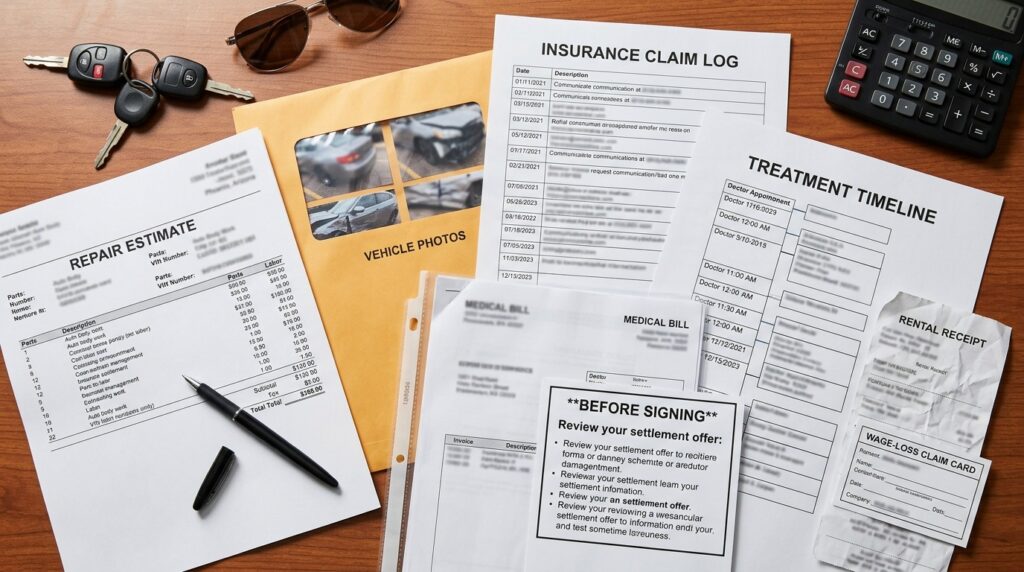
Vehicle damage and financial losses should be documented separately from medical care.
Save:
- Vehicle damage photos
- Repair estimates
- Supplemental repair estimates
- Body shop invoices
- Total-loss valuation paperwork
- Rental car receipts
- Towing receipts
- Storage bills
- Receipts for damaged personal property
- Child seat replacement documentation, if relevant
- Communications with repair shops
- Communications with insurers
If you missed work, save:
- Pay stubs
- Timesheets
- Employer letters
- Missed-shift confirmations
- Work restriction notes
- Contractor invoices
- Tax records
- Notes about reduced hours or changed duties
A recovery journal can also help document daily impact. Track pain levels, sleep problems, mobility limits, headaches, difficulty driving, missed activities, medication side effects, and changes in work or family responsibilities.
What Insurance Companies May Review
Insurance companies may evaluate a car accident claim by reviewing:
- Fault
- Crash report details
- Scene photos
- Witness statements
- Vehicle damage
- Medical records
- Treatment timelines
- Medical bills
- Prior injuries
- Work restrictions
- Lost wages
- Repair records
- Policy limits
- Recorded statements
- Social media activity
- Consistency across records
Strong documentation helps answer insurance questions with records instead of memory.
Common Insurance Disputes After a Phoenix Car Accident
Insurance disputes may arise even when the crash seems straightforward.
Common disputes include:
- The insurer says its driver was not at fault.
- The insurer says you were partly responsible.
- The insurer disputes the injury timeline.
- The insurer says treatment was delayed.
- The insurer says treatment was unnecessary.
- The insurer disputes medical bills.
- The insurer says vehicle damage was minor.
- The insurer questions lost wages.
- The insurer requests broad medical authorizations.
- The insurer asks for a recorded statement.
- The insurer delays while reviewing coverage.
- The insurer makes a low settlement offer.
- The insurer says policy limits are too low.
Evidence matters most when fault, injuries, or coverage are disputed.
Phoenix Road Safety Context
Phoenix’s Road Safety Action Plan is a citywide effort to evaluate data, identify a High Injury Network, and prioritize safety solutions. The High Injury Network helps identify problem locations and supports planning for safety enhancements citywide.
For a specific crash claim, Road Safety Action Plan materials do not prove fault. But local safety context can still help explain why location, road design, speed, lighting, intersections, crosswalks, and vulnerable road users may matter.
After a Phoenix crash, write down:
- Road name and cross street
- Direction of travel
- Lane position
- Nearby businesses
- Nearby cameras
- Crosswalks or signals
- Lighting conditions
- Construction or road hazards
- Weather
- Traffic conditions
- Whether pedestrians, cyclists, scooters, buses, rideshare vehicles, delivery drivers, or commercial vehicles were involved
Small location details can become important if fault, visibility, speed, right-of-way, or road conditions are disputed.
Arizona Deadlines and Public-Entity Notice Rules
Arizona car accident injury claims are time-sensitive. In many cases, injury-to-person actions must be commenced and prosecuted within two years after the cause of action accrues under Arizona Revised Statutes Section 12-542.
Some claims may have much shorter notice requirements. Under Arizona Revised Statutes Section 12-821.01, people with claims against a public entity, public school, or public employee must file a notice of claim with the authorized person within 180 days after the cause of action accrues.
That can matter if a crash involved a government vehicle, public employee, roadway condition, public transit issue, public school vehicle, or other public-entity question.
Do not wait to ask about deadlines. Evidence can disappear quickly. Vehicles may be repaired, witnesses may become hard to contact, and camera footage may be overwritten.
Arizona Comparative Fault
Arizona law can also affect recovery when fault is disputed. Arizona Revised Statutes Section 12-2505 addresses comparative negligence and defines claimant’s fault.
Insurance companies may argue that the injured person was distracted, speeding, following too closely, failed to avoid the crash, delayed medical care, ignored warnings, or gave inconsistent statements.
Because fault arguments can affect claim value, evidence is especially important.
Mistakes to Avoid After a Phoenix Car Accident
Avoid these common mistakes:
- Leaving the scene too quickly
- Failing to call police or emergency help when needed
- Not getting medical care
- Saying you are “fine” before symptoms are clear
- Failing to photograph the scene
- Forgetting heat and roadside safety
- Losing witness information
- Not tracking the crash report number
- Repairing the vehicle before taking damage photos
- Throwing away damaged property
- Ignoring insurance letters
- Giving broad recorded statements
- Guessing about speed, timing, fault, or injuries
- Signing broad medical authorizations
- Accepting a quick settlement before treatment is complete
- Posting crash details on social media
- Waiting too long to ask about deadlines
Small mistakes can give insurers reasons to delay, reduce, or deny a claim.
When Legal Guidance May Be Useful
Not every car accident claim requires a lawyer. However, legal guidance may be useful when injuries, insurance disputes, or long-term consequences are involved.
Consider speaking with a lawyer if:
- You needed emergency care
- You were hospitalized
- Medical treatment is ongoing
- You missed work
- Fault is disputed
- The insurer is blaming you
- The insurer delays or denies the claim
- A commercial vehicle was involved
- A rideshare vehicle was involved
- The crash involved a pedestrian, cyclist, motorcyclist, scooter rider, or child
- The other driver was uninsured or underinsured
- A hit-and-run driver was involved
- A government vehicle or public employee may be involved
- The settlement offer seems too low
- A loved one suffered a fatal injury
A lawyer may help preserve evidence, identify responsible parties, evaluate damages, communicate with insurers, and explain Arizona deadlines.
Phoenix Car Accident Action Board Checklist
Use this checklist after a crash.
Safety
- Check for injuries
- Call 911 when needed
- Move out of traffic if safe
- Turn on hazard lights
- Protect yourself from heat and roadway danger
- Avoid arguing about fault
Scene Evidence
- Photograph vehicle damage
- Photograph license plates
- Photograph road layout and signs
- Capture weather, lighting, and road conditions
- Note nearby cameras
- Collect witness details
Driver and Report Records
- Exchange driver information
- Exchange insurance information
- Save the crash report number
- Track Phoenix Police or ADOT report resources
- Save officer or agency details, if available
Medical and Loss Records
- Get medical care
- Save medical records and bills
- Save repair estimates
- Save rental and towing receipts
- Save wage-loss proof
- Track symptoms and daily limitations
Insurance and Deadlines
- Notify your insurer
- Get the adjuster’s name and contact information
- Keep an insurance call log
- Avoid guessing in statements
- Review documents before signing
- Ask about Arizona injury deadlines early
- Ask about 180-day notice issues if a public entity may be involved
FAQ
What should I do first after a car accident in Phoenix?
Check for injuries, call 911 when needed, move to safety if possible, protect yourself from heat and traffic, exchange information, take photos, collect witness details, seek medical care, and start saving insurance, medical, repair, and wage records.
Should I call police after a Phoenix car accident?
Call police or emergency help if anyone is injured, a driver leaves the scene, vehicles cannot be moved safely, traffic is blocked, impairment is suspected, insurance information is missing, or the crash caused serious damage.
How do I get a Phoenix crash report?
Phoenix Police public-record materials include traffic crash records among request types and direct users to the Police Public Record Request portal. ADOT also provides Arizona Crash Report forms and resources for law enforcement reporting.
What evidence should I save after a crash?
Save photos, videos, witness details, crash report information, medical records, repair estimates, rental receipts, insurance messages, wage records, and receipts for out-of-pocket expenses.
Should I talk to the insurance adjuster?
You may need to provide basic facts, but be careful with recorded statements, broad medical authorizations, or settlement discussions before understanding the full impact of the injury.
What if my pain starts days after the accident?
Seek medical care and explain when the crash happened and when symptoms began. Delayed symptoms can happen, but documentation is important.
What if the other driver does not have insurance?
Your own uninsured motorist coverage, underinsured motorist coverage, collision coverage, medical payments coverage, or rental coverage may become important depending on the policy and facts.
Can I bring a claim if I was partly at fault?
Possibly. Arizona comparative-fault law can affect the claim. Evidence is especially important when the insurance company argues that you share responsibility.
How long do I have to file a car accident lawsuit in Arizona?
In many Arizona injury cases, the general deadline is two years after the cause of action accrues. Some claims may involve shorter deadlines, including a 180-day notice-of-claim requirement for certain claims against public entities, public schools, or public employees.
Should I accept the first settlement offer?
Not without understanding the full value of the claim. Early offers may not include future medical care, lost earning ability, long-term pain, or complications that become clearer later.
Is this article legal advice?
No. This article is for general informational purposes only. Anyone dealing with a specific car accident claim should speak with a qualified legal professional about their situation.
Final Thoughts
After a car accident in Phoenix, the first few hours can shape the claim. Focus on safety, heat exposure, scene evidence, driver information, witness details, medical care, crash report tracking, insurance communication, repairs, wage records, and deadline questions.
You do not need to solve everything immediately. But you should protect your health, preserve evidence, keep records organized, communicate carefully with insurers, and ask questions before signing away important rights.