
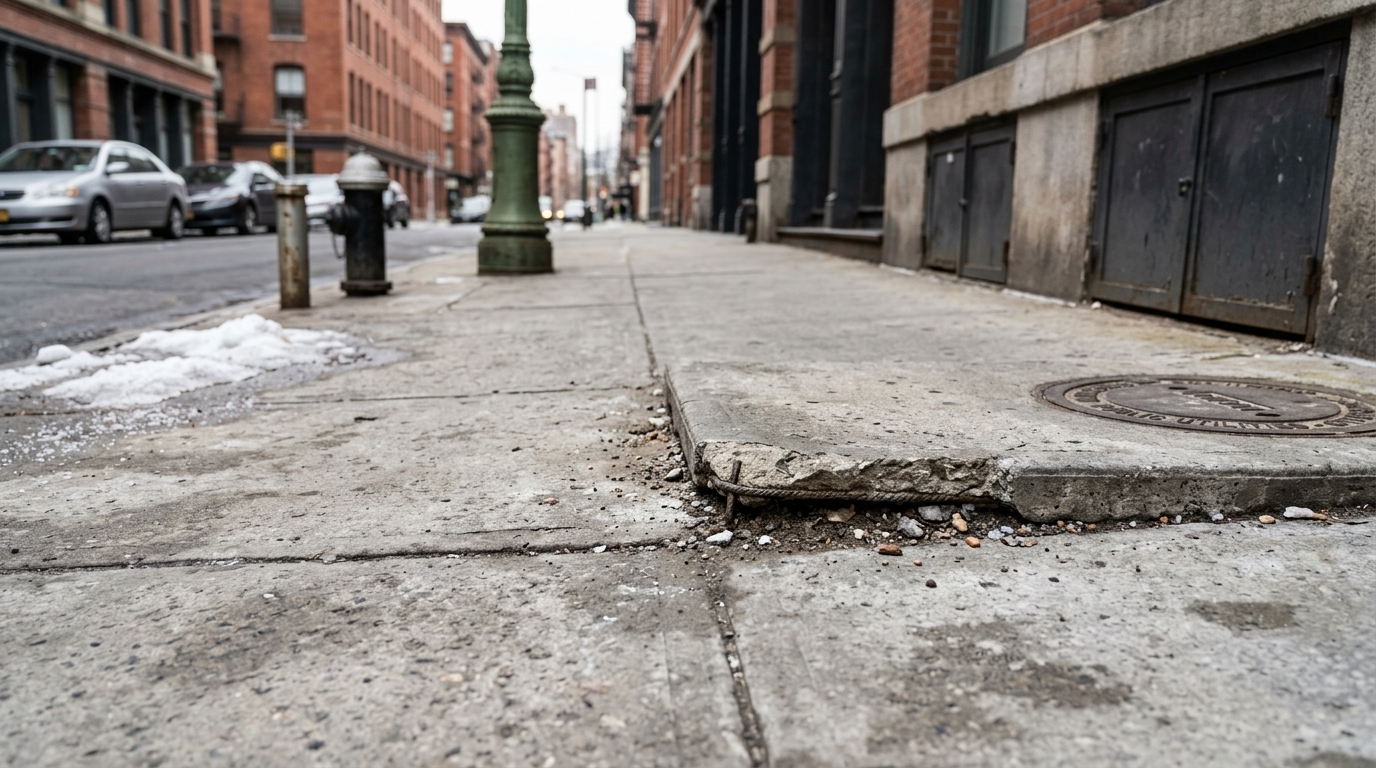
Trip and fall accidents can happen when sidewalks, parking lots, walkways, ramps, curbs, stairs, or entrances are uneven, cracked, poorly repaired, or not safely maintained. These claims often depend on location, property control, notice of the hazard, lighting, measurements, witness evidence, and medical documentation. People researching injury claims after a fall may review guidance from a trip and fall lawyer resource to understand how these cases are generally evaluated in New York.
Quick Answer
A broken sidewalk or parking lot trip claim usually requires proof that a dangerous walking surface existed, the responsible party owned, controlled, repaired, or maintained the area, and the hazard caused the injury. The injured person may also need to show that the responsible party created the defect, knew about it, or should have known about it through reasonable inspection. Photos, measurements, incident reports, witness statements, maintenance records, weather details, and medical records can all be important.
Key Takeaways
- Trip and fall claims usually depend on proof of a specific dangerous defect.
- Broken sidewalks, uneven pavement, potholes, raised slabs, damaged curbs, and poor lighting can all matter.
- Liability may involve property owners, businesses, landlords, tenants, parking lot operators, maintenance companies, contractors, or public entities.
- Notice is often a major issue, especially when the defect developed over time.
- Public sidewalk and municipal property claims may involve shorter notice requirements.
- Evidence should be collected quickly before repairs, resurfacing, weather, or cleaning change the condition.
- Medical records help connect the fall to the injury and document the seriousness of harm.
What Makes a Trip and Fall Different From a Slip and Fall?
A trip and fall usually involves a person’s foot catching on an object, height difference, hole, crack, raised edge, broken surface, or uneven walking area. A slip and fall usually involves loss of traction from water, ice, grease, wax, spilled liquid, snow, loose flooring, or another slippery substance.
This difference matters because the evidence can be different. A trip and fall claim often focuses on the physical shape, height, depth, and visibility of a defect. A slip and fall claim may focus more on a substance, wet surface, cleaning procedure, weather condition, or traction issue.
Examples of trip hazards may include:
- Raised sidewalk slabs
- Broken pavement
- Potholes
- Uneven parking lot surfaces
- Cracked walkways
- Damaged curbs
- Loose bricks or pavers
- Exposed tree roots
- Uneven ramps
- Missing transition strips
- Broken stairs
- Poorly marked changes in elevation
- Construction debris or loose materials
The key question is not only whether a defect existed. The claim usually needs to show that the defect was dangerous, connected to the fall, and legally tied to a responsible party.
Why Broken Sidewalks Cause Serious Injuries
Broken sidewalks can be dangerous because pedestrians often walk with normal expectations. A person may not expect a raised slab, deep crack, hidden hole, loose brick, or sudden elevation change in a public walkway or business entrance.
A fall on concrete or pavement can cause serious injuries, especially when the person falls forward and cannot brace properly. Common injuries may include wrist fractures, shoulder injuries, knee injuries, hip fractures, dental injuries, facial trauma, concussions, back injuries, neck injuries, torn ligaments, scarring, and chronic pain.
Older adults and people with mobility limitations may face greater injury risks. However, a severe fall can injure anyone, especially when the walking surface defect is abrupt, poorly lit, or difficult to see.
Parking Lot Trip Hazards
Parking lots are common locations for trip and fall accidents. They often include pavement cracks, potholes, drainage dips, faded markings, curbs, wheel stops, uneven asphalt, loose gravel, poor lighting, and transitions between the parking area and sidewalk.
A parking lot claim may involve several possible responsible parties. The property owner may be responsible for the lot. A store tenant may have maintenance obligations. A property management company may inspect the area. A paving contractor may have performed repairs. A snow removal or maintenance company may have contributed to the condition.
Parking lot evidence can change quickly because surfaces may be patched, repainted, resurfaced, or repaired. Clear photos and measurements are especially useful.

Who May Be Responsible for a Broken Sidewalk or Parking Lot Fall?
Responsibility depends on ownership, occupancy, control, maintenance duties, contracts, and local rules. A person or company may not need to own the property to have some responsibility for the walking surface. Control and maintenance duties can matter.
Potentially responsible parties may include:
- Property owners
- Commercial tenants
- Landlords
- Apartment complexes
- Shopping centers
- Parking lot operators
- Property management companies
- Maintenance contractors
- Paving contractors
- Snow and ice removal contractors
- Municipalities or public entities
- Utility companies in limited cases
- Construction contractors
A premises liability attorneys resource may help readers understand why property control, notice, inspection duties, and maintenance responsibility are central issues in fall-related injury claims.
Why Notice Matters in Trip and Fall Claims
Notice is often one of the most important parts of a trip and fall claim. A responsible party may be liable if they created the dangerous condition, actually knew about it, or should have known about it through reasonable inspection.
Actual notice means the party knew about the defect. For example, a tenant may have complained about a broken walkway, a store employee may have reported a pothole, or a maintenance worker may have documented a raised sidewalk slab.
Constructive notice means the defect existed long enough that the responsible party should have discovered and corrected it. This may depend on the age of the crack, prior complaints, inspection records, maintenance history, surveillance footage, repair logs, or whether the defect was visible and apparent.
A newly created defect may be harder to prove than a long-standing hazard. However, each case depends on the evidence.
Sidewalk Liability in New York
Sidewalk liability in New York depends heavily on location. In New York City, certain abutting property owners may have a duty to maintain sidewalks in a reasonably safe condition under New York City Administrative Code § 7-210. That rule is specific to New York City and does not automatically answer every sidewalk claim across the state.
Outside New York City, sidewalk responsibility may depend on local laws, property ownership, municipal rules, prior written notice requirements, maintenance agreements, and whether a private owner created or worsened the defect.
This is why the exact fall location matters. A sidewalk outside a commercial building may involve different rules than a sidewalk near a public park, municipal building, school, residential property, or private business.
Public Sidewalks and Municipal Claims
If the fall occurred on public property, municipal notice rules may become important. Claims involving public sidewalks, public parking lots, municipal buildings, school property, public parks, bus stops, or government-controlled walkways may have much shorter deadlines than ordinary negligence claims.
New York’s General Municipal Law § 50-e generally requires a notice of claim within 90 days for certain tort claims against public corporations. That deadline can be critical when a city, town, village, school district, public authority, or other public entity may be involved.
Some municipal sidewalk claims may also involve prior written notice rules. These rules can require proof that the municipality had written notice of the specific defect before the accident, unless an exception applies. The exact rule depends on the location and responsible public entity.
What Evidence Helps Prove a Broken Sidewalk Claim?
A strong sidewalk claim usually needs detailed evidence of the defect. General statements such as “the sidewalk was bad” may not be enough. The condition should be documented as clearly as possible.
Helpful evidence may include:
- Close-up photos of the defect
- Wide-angle photos showing the exact location
- Measurements of height difference, crack depth, or hole size
- Video showing the walking path
- Photos from multiple angles
- Nearby landmarks, addresses, or storefronts
- Witness names and contact details
- Incident reports
- Surveillance footage
- Prior complaints
- Repair records
- Municipal records
- Maintenance logs
- Weather conditions
- Medical records
- Photos of footwear
- Proof of lost wages
Measurements can be especially helpful. A raised slab, pothole, or uneven edge should be documented with a ruler, tape measure, or another clear object for scale when it is safe to do so.

What Evidence Helps Prove a Parking Lot Claim?
Parking lot claims often require evidence showing the exact hazard and who controlled the area. Since parking lots may be large and visually repetitive, location details are important.
Helpful evidence may include:
- Photos showing the defect and nearby parking spaces
- Lot section, aisle, or row information
- Nearby store entrance or building reference points
- Lighting conditions
- Surveillance footage
- Incident report from the business or property manager
- Pavement repair history
- Snow or ice removal records, if relevant
- Drainage or resurfacing records
- Maintenance contracts
- Witness statements
- Medical treatment records
- Lost income documentation
A parking lot defect may be easier to prove when there is clear evidence that the condition existed for a significant period or had been reported before.
Poor Lighting and Visibility Issues
Poor lighting can make an uneven surface harder to see. A parking lot pothole, broken curb, or raised pavement edge may be especially dangerous at night or during early morning hours.
Lighting evidence may include photos taken at the same time of day, maintenance records for lights, witness statements, surveillance footage, or records showing broken bulbs or unlit areas.
Visibility can also be affected by shadows, faded markings, weather, leaves, snow piles, construction materials, or poor contrast between pavement surfaces. These details may help explain why a pedestrian did not see the hazard in time.
Comparative Fault in New York Trip and Fall Claims
Property owners and insurers may argue that the injured person should have seen the defect, was not paying attention, wore unsafe shoes, walked too quickly, ignored warning signs, or used a phone while walking.
New York’s comparative negligence rule under Civil Practice Law & Rules § 1411 generally means that a claimant’s own fault does not automatically bar recovery, but damages may be reduced based on the person’s share of responsibility.
This is why evidence matters. Photos, lighting conditions, witness statements, defect measurements, and video footage may help explain whether the hazard was open and obvious, hidden, poorly marked, or unreasonably dangerous.
Medical Documentation After a Trip and Fall
Medical care should be documented after a serious trip and fall. Some injuries are immediate, while others worsen over time. Medical records can help show the connection between the fall and the injury.
Important records may include:
- Emergency room reports
- Urgent care notes
- Orthopedic evaluations
- Imaging reports
- Physical therapy notes
- Surgical records
- Pain management records
- Work restriction notes
- Follow-up treatment records
- Prescription records
Consistent treatment can help show injury progression and long-term impact. Gaps in treatment may be used by insurers to question whether the fall caused the injury or whether the injury was serious.

Common Injuries From Broken Sidewalk and Parking Lot Falls
Trip and fall accidents can cause significant injuries because the person often falls forward onto a hard surface. The hands, knees, shoulders, face, head, and hips may absorb the impact.
Common injuries may include:
- Wrist fractures
- Arm fractures
- Hip fractures
- Shoulder tears
- Knee injuries
- Ankle injuries
- Facial injuries
- Dental injuries
- Concussions
- Back injuries
- Neck injuries
- Torn ligaments
- Scarring
- Chronic pain
The seriousness of the injury can affect the value and complexity of the claim. A claim involving surgery, permanent limitation, lost income, or long-term treatment may require deeper documentation than a minor injury claim.
Deadlines for Trip and Fall Claims in New York
Deadlines vary depending on the responsible party and the location of the fall. The New York Courts statute of limitations timetable lists three years for many negligence-based personal injury claims. However, shorter deadlines may apply when a public entity is involved.
This is especially important for sidewalk and parking lot cases because the responsible party may not be obvious at first. A private owner, commercial tenant, municipality, contractor, or property manager may all need to be identified.
The safest approach is to preserve evidence and identify the responsible parties as early as possible.
Common Mistakes After a Trip and Fall
Some mistakes can make a valid claim harder to prove.
Common mistakes include:
- Leaving without reporting the fall
- Not photographing the exact defect
- Taking only close-up photos without showing location context
- Not measuring the height difference or hole depth
- Failing to identify witnesses
- Waiting too long to seek medical treatment
- Throwing away damaged shoes or clothing
- Not asking whether surveillance footage exists
- Assuming the property owner is automatically liable
- Posting about the accident on social media
- Missing public entity notice deadlines
A strong claim usually depends on clear proof of where the fall happened, what caused it, who was responsible, and how the injury affected the person’s life.
When Legal Guidance May Be Useful
Legal guidance may be useful when a trip and fall caused serious injury, the property owner denies responsibility, the defect was repaired quickly, the fall happened on public property, a parking lot contractor may be involved, or an insurer argues the injured person was at fault.
People researching local resources may review a Farmingdale legal office location when looking for Long Island fall claim information. Publicly available trip and fall case results may also help readers understand how serious fall-related injury matters can vary, although every claim depends on its own evidence, injuries, and available coverage.
FAQs About Broken Sidewalk and Parking Lot Trip Claims
Is a property owner automatically liable for a broken sidewalk fall?
No. A property owner is not automatically liable simply because a fall happened. The injured person usually needs evidence of a dangerous defect, legal responsibility for the area, notice or creation of the hazard, causation, and damages.
What should someone photograph after a trip and fall?
Photos should show the exact defect, the surrounding area, nearby landmarks, lighting, warning signs, and the walking path. Close-up photos and wide-angle photos are both useful. Measurements of the height difference, crack, hole, or broken surface can also help.
Can a parking lot operator be responsible for a trip hazard?
Yes, a parking lot operator, property owner, tenant, maintenance company, or contractor may be responsible depending on who controlled, inspected, repaired, or maintained the area. The answer depends on contracts, property records, maintenance logs, and the facts of the fall.
What if the sidewalk was public property?
Public property claims may involve shorter notice requirements and special rules. If a municipality or public entity may be responsible, a notice of claim may be required much earlier than the ordinary personal injury deadline.
Can someone still recover if they were partly at fault?
Yes. New York comparative negligence rules generally allow recovery even when the injured person shares some fault, but compensation may be reduced based on the assigned percentage of responsibility.
Final Thoughts
Broken sidewalk and parking lot trip claims depend on specific evidence. The exact defect, location, visibility, maintenance history, responsible party, notice, and medical records all matter. Because walking surfaces can be repaired quickly and public entity deadlines may be short, early documentation is especially important. Clear photos, measurements, witness details, incident reports, and treatment records can help explain how the fall happened and why the hazard should not have been ignored.