

One of the first questions after a serious Houston car accident is also one of the hardest to answer:
How much is my case worth?
There is no reliable universal calculator.
Two people can be injured in crashes that look similar but end up with very different claims because their injuries, treatment, work losses, insurance coverage, fault evidence, and long-term effects are different.
A more useful way to think about case value is as a range that becomes clearer as evidence develops.
Early in the claim, that range can be wide. As medical treatment progresses, fault evidence is collected, insurance coverage is identified, and wage losses become documented, the range can become more realistic.
Quick Answer
The value of a Houston car accident case may depend on:
- How clearly the other party can be shown to be at fault
- Whether you share responsibility for the crash
- The nature and severity of your injuries
- Medical treatment and expenses
- Whether future treatment is expected
- Lost wages and changes in earning ability
- Pain, physical limitations, and other injury effects
- Damage to the vehicle and other property
- Available insurance coverage
- Whether the at-fault driver is uninsured or underinsured
- Quality and consistency of the evidence
- Whether there are treatment gaps or causation disputes
- Whether the case settles or proceeds further through litigation
A case cannot usually be valued responsibly from the crash report alone.
Key Takeaways
- There is no legitimate fixed multiplier or online calculator that can determine every Houston accident claim.
- Case value is built from documented losses and the strength of the liability evidence.
- Medical treatment often changes the value picture as diagnoses and future-care needs become clearer.
- Texas proportionate-responsibility rules can reduce or prevent recovery when fault is shared.
- Insurance limits can affect how much compensation is realistically collectible even when losses are substantial.
- PIP and UM/UIM coverage may create additional sources of benefits depending on the policy.
- A fast settlement can undervalue a claim if treatment, wage loss, or future medical needs are still developing.
The Houston Case Value Range Builder
Think of the claim as six moving variables.
| Value Variable | Questions That Affect the Range |
| Fault | Who caused the crash, and can it be proved? |
| Injury | How serious and lasting are the injuries? |
| Treatment | What care was required, and what may be needed later? |
| Income | How much work and earning ability were affected? |
| Coverage | What insurance or other sources of recovery exist? |
| Evidence | How well can each part of the claim be documented? |
A strong case usually requires these variables to support one another.
High medical bills alone do not automatically establish high case value.
Clear fault alone does not establish the extent of injury.
A severe injury may create significant losses, but available coverage can still affect practical recovery.
1. Fault Sets the Starting Position
Before discussing damages, a claim usually needs a credible explanation of why another person or entity is legally responsible.
Useful fault evidence may include:
- Police crash report
- Scene photographs
- Vehicle damage
- Dashcam footage
- Traffic-camera footage
- Nearby surveillance
- Witness statements
- Roadway markings
- Signal information
- Driver statements
- Electronic vehicle information when available
Consider a Houston rear-end crash.
If photographs, witnesses, and vehicle positions clearly show that one driver struck a stopped vehicle at a red light, the liability dispute may be relatively narrow.
Compare that with a collision in a complicated intersection where both drivers claim the other entered against the signal.
The injuries could be identical, but the second claim may carry greater liability risk.
2. Shared Fault Can Change the Value
Texas uses a proportionate-responsibility system in covered cases.
That means a claimant’s own percentage of responsibility can matter.
For example, disputes may involve allegations that a driver:
- Changed lanes unexpectedly
- Was speeding
- Failed to keep a proper lookout
- Entered an intersection improperly
- Followed too closely
- Failed to yield
- Was distracted
Texas law provides that a claimant generally may not recover damages in an action governed by Chapter 33 if the claimant’s percentage of responsibility is greater than 50%.
When the claimant’s responsibility is 50% or less, that percentage can affect the damages recoverable under the applicable rules.
That makes fault evidence part of the value equation rather than a separate issue.
A Simple Illustration
Suppose two claims involve the same documented losses.
In Claim A, liability is strongly supported and little credible evidence points toward shared fault.
In Claim B, substantial evidence suggests the injured driver may also have contributed to the collision.
Even before discussing insurance coverage, the realistic settlement ranges may be different.

3. Injury Severity Is More Important Than Vehicle Damage Alone
Insurance discussions often focus heavily on property damage.
But vehicle damage and physical injury do not always track perfectly.
A claim involving temporary soreness that resolves quickly is fundamentally different from one involving:
- Fracture
- Surgery
- Traumatic brain injury
- Spinal injury
- Significant nerve symptoms
- Permanent scarring
- Long-term mobility limitation
- Chronic pain
- Ongoing rehabilitation
Even among people with similar diagnoses, outcomes can vary.
One person may return to normal activity in several weeks.
Another may continue to experience symptoms for months or require specialist treatment.
That is why case value often becomes clearer only after the medical picture develops.
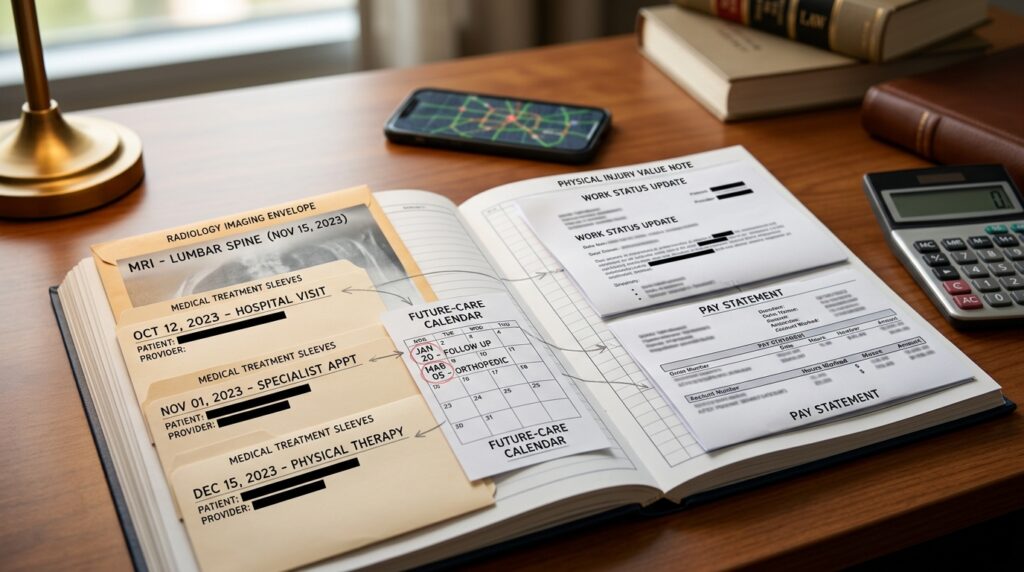
4. Medical Treatment Builds the Damages Record
Medical treatment does two jobs in a car accident claim.
First, it addresses the person’s health.
Second, it creates documentation showing what injuries were reported, diagnosed, and treated.
Potential records include:
- Emergency department records
- Urgent care records
- Primary care records
- Diagnostic imaging
- Specialist evaluations
- Physical therapy
- Prescription records
- Surgery records
- Work restrictions
- Future-treatment recommendations
Insurance companies may examine both the amount of care and its connection to the crash.
Questions can include:
- When did symptoms begin?
- When was the first medical visit?
- Were the same symptoms reported consistently?
- Was treatment medically recommended?
- Were there significant gaps?
- Did symptoms improve?
- Did imaging reveal an injury?
- Is future care expected?
The medical file should tell a coherent story rather than simply contain a stack of bills.
5. Medical Bills Are Important—but the Sticker Price Is Not the Whole Answer
People often estimate case value by adding all medical charges and applying a multiplier.
That approach can be misleading.
Texas law specifically addresses recovery of medical or health-care expenses. Section 41.0105 of the Texas Civil Practice and Remedies Code limits recovery of incurred medical or health-care expenses to amounts actually paid or incurred by or on behalf of the claimant.
That means the relationship among billed amounts, paid amounts, adjustments, and legally recoverable expenses can require closer review.
Useful documents can include:
- Itemized medical bills
- Health insurance explanations of benefits
- Payment ledgers
- Provider statements
- Outstanding balances
- Letters concerning liens or reimbursement interests
- PIP or MedPay payment records
The medical-economic portion of a claim should therefore be built from actual documentation rather than assumptions based solely on the initial billed total.
6. Future Medical Care Can Move the Value Range
A settlement reached while treatment is still developing may be difficult to evaluate.
Consider the difference between these two situations:
Case A: The injured person completes several weeks of treatment, symptoms resolve, and no future care is recommended.
Case B: Imaging reveals a significant injury, conservative treatment does not resolve symptoms, a specialist recommends additional procedures, and work restrictions continue.
The future-care picture is different.
Questions that may affect valuation include:
- Has treatment ended?
- Has the person reached a stable medical condition?
- Is additional imaging needed?
- Has a specialist recommended treatment?
- Is surgery being considered?
- Will rehabilitation continue?
- Are medications likely to continue?
- Are future medical costs reasonably supported?
A release signed too early can become important because settling the bodily-injury claim generally means giving up the ability to seek additional money for that accident from the settling insurer.
The Texas Department of Insurance specifically advises consumers to consider future medical treatment before signing a medical settlement release.
7. Lost Income Requires Its Own Proof
Missing work after a crash does not automatically establish a wage-loss amount.
The loss needs documentation.
Useful records may include:
- Pay stubs
- Employer wage verification
- Timesheets
- Missed-shift records
- Work restriction notes
- Tax records
- Direct-deposit history
- Commission records
- Bonus history
- Used sick leave
- Used vacation time
For self-employed people, the proof can become more complicated.
Relevant materials might include:
- Tax returns
- Profit-and-loss statements
- Customer invoices
- Contracts
- Canceled appointments
- Business bank records
- Comparable pre-crash earnings
The strongest wage-loss record usually connects medical restrictions to measurable income changes.
8. Lost Earning Ability Can Be Different From Missed Paychecks
Some serious injuries affect more than past wages.
A person may return to work but no longer be able to:
- Lift the same weight
- Work the same hours
- Drive commercially
- Perform physical labor
- Travel for work
- Stand for long periods
- Perform repetitive tasks
- Continue in the same occupation
That raises a different question:
Did the injury affect the person’s ability to earn income in the future?
Evaluating that issue may require more than adding missed paychecks.
Depending on the case, useful evidence can include:
- Medical restrictions
- Employment history
- Education and training
- Pre-injury earnings
- Post-injury earnings
- Job duties
- Career trajectory
- Expert analysis in disputed or significant cases
Not every accident creates a loss of earning capacity.
But when it does, the amount may be more significant than the person’s initial time away from work.
9. Daily-Life Impact Is Not Captured by Receipts Alone
Some consequences of an injury do not produce an invoice.
Examples may include:
- Persistent physical pain
- Difficulty sleeping
- Reduced mobility
- Inability to exercise
- Difficulty caring for children
- Loss of independence
- Difficulty completing household tasks
- Reduced participation in hobbies
- Physical impairment
- Scarring or disfigurement
These effects must still be supported by credible evidence.
Medical records, testimony, photographs, treatment history, and descriptions of specific before-and-after limitations may become relevant.
Vague claims such as “everything changed” are usually less useful than concrete examples.
For instance:
Before the crash, the person routinely performed a physically demanding job and coached youth sports. After the crash, documented lifting restrictions prevented both activities for several months.
Specific evidence makes the impact easier to understand.
10. Insurance Coverage Creates the Practical Recovery Range
A person can have significant documented damages while facing an insurance problem.
Texas requires drivers to carry minimum liability insurance, but minimum limits may be inadequate in a serious injury crash.
That is where other coverage may matter.
Depending on the facts and the policy, possible sources can include:
- At-fault driver’s liability insurance
- Personal injury protection
- Medical payments coverage
- Uninsured motorist coverage
- Underinsured motorist coverage
- Employer or commercial coverage
- Other applicable policies
Texas insurers must offer PIP and UM/UIM coverage with new personal auto policies, although policyholders can reject those coverages in writing.
That makes the injured person’s own declarations page worth reviewing.
Why Underinsured Coverage Can Matter
Imagine a driver causes a crash resulting in substantial medical treatment and lost income but carries liability limits that are lower than the injured person’s supported losses.
The liability policy does not necessarily define the person’s total damages.
But it may limit what can be recovered from that insurer under that policy.
If the injured person has applicable underinsured motorist coverage, that policy may become another part of the analysis.
Coverage issues can therefore create two separate questions:
- What are the claim’s supported damages?
- What sources are available to pay them?
Those are not always the same number.
11. Hit-and-Run and Uninsured Drivers Change the Analysis
Houston crashes sometimes involve:
- Drivers without insurance
- Drivers with inadequate insurance
- Hit-and-run vehicles
- Disputes over whether coverage applies
Texas Department of Insurance guidance explains that UM/UIM coverage can help when an at-fault driver has no insurance, not enough insurance, or cannot be identified after a hit-and-run, subject to policy terms and applicable requirements.
PIP and medical payments coverage may also help with medical expenses depending on the policy.
This is why a claim should not always be evaluated from the other driver’s insurance information alone.

12. Strong Evidence Can Protect the Value Range
A legitimate injury can become harder to value when the evidence is incomplete.
Potential problems include:
- No scene photographs
- No witness information
- Long delay before treatment
- Unexplained treatment gaps
- Inconsistent descriptions of symptoms
- Missing wage records
- Missing insurance correspondence
- Lost receipts
- Conflicting statements
- Social media content inconsistent with claimed limitations
None of these automatically destroys a case.
But each can create an issue that must be explained.
A stronger claim file often contains:
Liability Evidence
- Crash report
- Photos
- Video
- Witnesses
- Vehicle damage documentation
Medical Evidence
- Treatment records
- Bills
- Imaging
- Specialist reports
- Work restrictions
Financial Evidence
- Wage records
- Employer verification
- Receipts
- Out-of-pocket expenses
Coverage Evidence
- Policy declarations
- Claim correspondence
- Liability limits information when available
- PIP or UM/UIM documentation
The goal is to make the claim verifiable.
13. Treatment Gaps Can Create a Value Dispute
Life does not stop after an accident.
People may miss medical appointments because of:
- Work
- Childcare
- Transportation
- Cost
- Insurance problems
- Scheduling delays
- Referral delays
But an insurer may view a long unexplained treatment gap differently.
It may argue that:
- The injury improved
- Treatment was unnecessary
- Another event caused later symptoms
- The collision was not responsible for ongoing complaints
If there is a legitimate reason for a gap, document it.
The issue is often not whether every appointment was perfect.
It is whether the timeline can be understood.
14. Prior Injuries Do Not Automatically Erase a New Claim
Many adults have prior medical history.
Previous back pain, neck problems, arthritis, old injuries, or earlier accidents do not automatically mean a new crash caused no harm.
The important questions may include:
- What was the person’s condition before the crash?
- Were symptoms active immediately beforehand?
- Did the collision cause a new injury?
- Did it aggravate an existing condition?
- What changed after the crash?
Medical records can be particularly important when causation is disputed.
Trying to hide a prior condition can create a credibility problem.
A more useful approach is to document the before-and-after difference accurately.
15. Vehicle Damage Can Affect the Discussion—but It Is Not a Settlement Formula
Insurers may compare injury allegations with the physical collision.
Relevant evidence can include:
- Repair estimate
- Total-loss evaluation
- Photos of damage
- Airbag deployment
- Tow records
- Vehicle structure
- Direction of impact
But the repair bill alone does not calculate bodily injury.
Vehicle design, occupant position, impact direction, prior conditions, and individual medical outcomes can differ significantly.
The proper question is not:
“How much damage was done to the bumper?”
It is:
“What does all the evidence show happened to this particular person?”
16. Houston Crash Context Can Affect the Evidence
Houston’s roadway environment can make collision evidence especially important.
Serious crashes occur across corridors such as:
- I-45
- I-10
- I-69 / US 59
- Loop 610
- Beltway 8
- US 290
- Westheimer Road
- FM 1960
- Richmond Avenue
- Telephone Road
Dense freeway traffic, frontage roads, complex interchanges, frequent lane changes, commercial traffic, and large intersections can create disputes over exactly how a crash occurred.
The City of Houston’s Vision Zero program has documented the serious-injury and fatal-crash burden on Houston streets.
That citywide safety context does not establish the value or fault of any individual case.
But it reinforces why roadway location, traffic conditions, vehicle movement, and injury documentation deserve case-specific attention.
17. A Quick Settlement Is Not the Same as a Fair Valuation
A fast insurance offer can be appealing.
Medical bills may already be arriving.
A vehicle may be unavailable.
The injured person may be missing work.
But the timing of the offer matters.
Before evaluating a final bodily-injury settlement, useful questions include:
- Is medical treatment complete?
- Is the diagnosis clear?
- Is future care expected?
- Are all bills available?
- Are wage losses documented?
- Is there applicable PIP or UM/UIM coverage?
- Are liability disputes resolved?
- Are there liens or reimbursement issues?
- Does the release end all further claims from the accident?
The Texas Department of Insurance warns that another driver’s insurer may ask the injured person to sign a release as part of a medical settlement and recommends considering future medical treatment before signing.
That makes settlement timing part of case valuation.
What Can Increase a Houston Car Accident Claim’s Supported Value?
No single factor guarantees a particular settlement.
But a stronger damages picture may involve:
- Clear evidence of fault
- Significant objectively documented injury
- Prompt and consistent treatment
- Specialist care when medically necessary
- Reasonably supported future treatment
- Documented wage loss
- Lasting physical limitations
- Strong before-and-after evidence
- Consistent medical and factual records
- Adequate insurance coverage
What Can Reduce or Complicate the Value?
Common complications can include:
- Significant shared fault
- Weak liability evidence
- Minor or rapidly resolved injuries
- Delayed treatment without explanation
- Large treatment gaps
- Causation disputes
- Inconsistent records
- Undocumented wage claims
- Low available insurance limits
- Prior injuries that are poorly distinguished from the new condition
- Premature settlement
These factors should be evaluated individually rather than through an automatic deduction formula.
A Practical Houston Case Value File
Organize the claim into six sections.
1. Fault File
Save:
- Crash report
- Photos
- Video
- Witness contacts
- Driver information
2. Medical File
Save:
- Records
- Bills
- Imaging
- Referrals
- Therapy records
- Future-care recommendations
3. Work File
Save:
- Pay stubs
- Missed-time records
- Work restrictions
- Employer letters
- Tax documents if self-employed
4. Daily Impact File
Track:
- Mobility limitations
- Sleep disruption
- Household limitations
- Missed activities
- Pain changes
5. Insurance File
Save:
- Declarations page
- Claim numbers
- Liability correspondence
- PIP information
- UM/UIM correspondence
- Coverage letters
6. Settlement File
Before signing a release, confirm:
- Treatment status
- Outstanding bills
- Future-care questions
- Wage documentation
- Coverage issues
- What rights the release ends
A well-organized file does not guarantee a certain settlement.
It makes the value discussion more evidence-based.
When Does a Case Become Easier to Value?
Case valuation generally improves when major unknowns are resolved.
For example:
- Fault evidence has been collected.
- Insurance coverage has been identified.
- The diagnosis is established.
- Treatment has progressed enough to understand recovery.
- Future care is known or reasonably predictable.
- Wage loss is documented.
- Permanent limitations, if any, are clearer.
That does not mean every claim must wait indefinitely.
It means valuation is more reliable when it is based on evidence rather than guesses.
Someone with significant injuries or uncertainty about coverage may choose to discuss those variables with a best car accident lawyer houston before evaluating a final settlement.
For more detailed information about collision claims, car accident lawyers may also help identify which damages and insurance records should be reviewed.
Texas Deadlines Still Matter While the Value Develops
Waiting for the medical picture to develop does not mean legal deadlines stop.
Texas Civil Practice and Remedies Code Section 16.003 generally provides a two-year limitations period for personal-injury suits, subject to exceptions and circumstances that may change the analysis.
That creates an important distinction:
A claim may need time to become medically clear, while its legal deadlines continue to run.
Insurance negotiations generally should not be assumed to extend a statutory deadline.
FAQ
There is no reliable average that can predict an individual claim. Settlement value depends on the specific injuries, treatment, fault evidence, lost income, insurance coverage, future losses, and other facts. Published averages can be misleading because they combine very different cases.
Not as a universal rule. A fixed multiplier does not account for liability disputes, injury severity, future treatment, wage loss, Texas medical-expense rules, insurance limits, or evidence quality. A claim should be evaluated from its actual documented losses and facts.
It can. The physical and personal effects of an injury may be relevant depending on the case, but they should be supported by credible evidence such as medical records, treatment history, testimony, and specific documented limitations.
Applicable uninsured/underinsured motorist coverage may become relevant if it was included in the injured person’s policy and the legal and policy requirements are satisfied. Texas insurers must offer UM/UIM coverage on new personal auto policies unless it is rejected in writing.
Use caution. If the injury picture is still developing, it may be difficult to account for future treatment or ongoing limitations. The Texas Department of Insurance advises consumers to discuss possible future medical treatment with their doctor before signing a medical settlement release.
Final Thoughts
A Houston car accident case does not have a hidden price tag waiting to be discovered.
Its value is built from evidence.
Start with fault.
Then document the injury.
Track medical care and future treatment.
Measure work and income losses.
Identify every relevant insurance source.
Preserve evidence that supports the connection between the collision and the losses.
As those pieces become clearer, the realistic value range usually becomes clearer too.
The central question is not “What do similar cases settle for?”
It is:
“What can the evidence prove about this crash, this injury, this person’s losses, and the coverage available to pay them?”
For local directions and contact information, the Thompson Law Houston profile provides a Houston starting point.